Blog
Blog
From Industry 4.0 to 5.0: Human-Centric Innovation and Embracing Industrial Agentic AI
Omid Givehchi · 26 October 2025
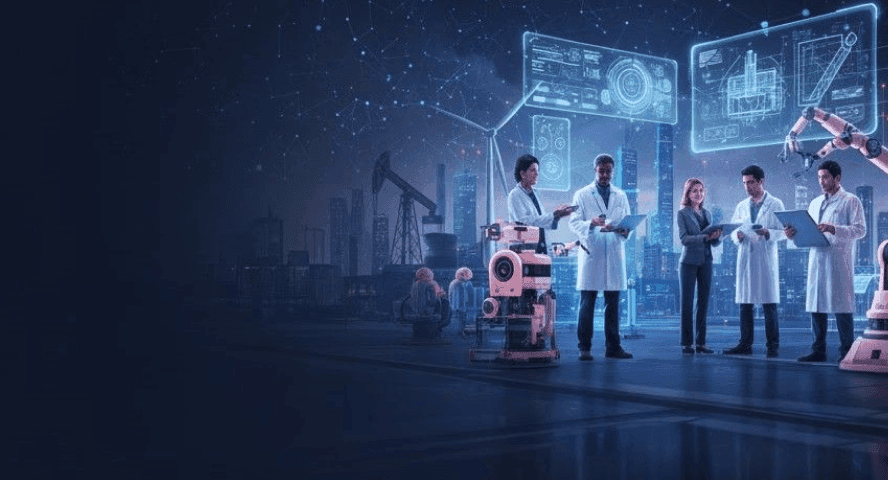
We have all heard about Industry 4.0, connected machines, smart factories, IoT and lightning-fast supply chains. But as technology matures and the challenges grow, a new paradigm is emerging: Industry 5.0. It’s not just about smarter machines, it’s about smarter collaborations, augmented people, and autonomous AI Agentic systems NOT by replacing human but empowering them with the technology.
At the heart of this shift is Agentic AI: autonomous, goal-driven AI systems that don’t just analyze data, they act, adapt, and partner with the human-centric operations. The result? Industries across sectors not just manufacturing but energy, oil & gas, smart cities, factories and buildings are being re-imagined and re-engineered.
1. The Evolution: From Automation to Augmentation
Every industrial revolution has redefined what progress means. Industry 1.0 harnessed steam power to mechanize production. Industry 2.0 scaled output through electricity and assembly lines. Industry 3.0 introduced computers and early automation. Then came Industry 4.0, the digital transformation era connecting machines, sensors, and systems into intelligent, data-driven networks.
For more than a decade, Industry 4.0 delivered remarkable gains in efficiency, speed, and precision. Factories became smart. Supply chains became visible. Processes became predictive. But as global systems grew more complex, leaders began to see the limits of pure automation. Automation excels at repetition; it struggles with uncertainty, ethics, and emotion the very dimensions that shape today’s industrial, environmental, and social challenges.
That’s where Industry 5.0 emerges not as a replacement, but as an evolution. It asks a deeper question: What if the goal is not just optimization, but harmony? Harmony between humans and machines. Between productivity and sustainability. Between profit and purpose.
From Machine-Centric to Human-Centric Systems
In Industry 4.0, humans monitored systems; in Industry 5.0, they co-create with them. The focus shifts from “smart manufacturing” to “intelligent collaboration” where technology amplifies human creativity rather than replacing it. Machines now sense and adapt, but it’s humans who define meaning, values, and long-term goals.
Imagine a production environment where robotic arms adjust automatically to ergonomic needs, or energy grids that balance output not only for efficiency but for environmental and social impact. These are not far-fetched visions they’re prototypes of Industry 5.0 in action.
Beyond Manufacturing: The Cross-Industry Shift
While early discussions of Industry 5.0 centered on factory floors, the philosophy extends far beyond manufacturing. In energy and utilities, it means resilient grids that respond autonomously to climate volatility while aligning with human oversight and community priorities. In oil & gas, predictive AI systems prevent hazards and reduce waste while workers focus on innovation and sustainability. In smart cities and buildings, networks of sensors and AI agents adapt lighting, climate, and mobility flows around human comfort, accessibility, and carbon neutrality.
Every sector from logistics to healthcare to construction — is converging toward one shared vision: systems that learn from humans as much as humans learn from systems.
From Linear Efficiency to Systemic Intelligence
Industry 4.0 was about digitizing the known. Industry 5.0 is about navigating the unknown. It’s a shift from linear, rules-based optimization to dynamic, adaptive ecosystems. Instead of top-down command chains, organizations evolve into living networks where distributed AI agents and human teams co-decide and co-evolve.
The most forward-thinking companies are already piloting this approach integrating Agentic AI to create self-healing production lines, context-aware energy systems, and responsive city infrastructures. Each success story reinforces a new principle: that innovation flourishes when human purpose drives technological power.
The Human Edge
In the age of limitless automation, humanity becomes the ultimate differentiator. Empathy, creativity, ethics, and cross-domain reasoning these are the skills that will define competitive advantage in the 5.0 era. Technology will keep getting smarter, but humans will determine how wisely it’s used.
Industry 5.0 is therefore not just an industrial framework it’s a philosophy of coexistence. It challenges organizations to move beyond doing things faster, and instead, to do things better, together.
2. Agentic AI: The Engine of Industry 5.0
If Industry 4.0 was about automation, Industry 5.0 is about autonomy not just machines following pre-programmed rules, but intelligent systems capable of setting goals, learning continuously, and collaborating with humans. This evolution is powered by Agentic AI: autonomous, context-aware systems that can sense, reason, plan, and act all while aligning with human objectives and ethical constraints.
Unlike traditional AI, which processes data and waits for human direction, agentic AI systems take initiative. They analyze real-time conditions, make local decisions, and coordinate with other agents or humans to reach shared goals. The result is a system that not only responds to change but anticipates it, continuously optimizing for resilience, performance, and sustainability.
Agentic AI brings automation into the realm of co-creation. Unlike traditional AI systems that output recommendations, agentic AI systems sense, decide and act in real time. Some Examples:
- In manufacturing: when a machine fails, an AI agent reroutes tasks, minimizes downtime, and human engineers focus on innovation.
- In energy & utilities: agents balance renewable supply, manage grid loads, and humans oversee strategy and sustainability.
- In smart cities & buildings: systems learn occupant patterns, adjust climate/energy autonomously, enabling human teams to focus on design, wellbeing and community.
- In oil & gas: predictive agents detect anomalies early, reduce risk, and free human experts to focus on strategy and governance.
Ultimately, Agentic AI turns data into decisions and decisions into action, bridging the gap between digital intelligence and real-world impact. It transforms AI from a tool that serves automation into a partner for innovation one that embodies the essence of Industry 5.0: human creativity, ethical purpose, and technological autonomy, all working in harmony.
The key is human-AI synergy: machines take on repetitive, optimized tasks; humans bring vision, ethics and creativity. What results is resilient, adaptive, purposeful industry.
3. Why This Matters for Business Leaders
For C-level decision-makers, this transformation demands a shift in mindset:
- From central control → to coordinated autonomy. Empowering local decision-making through AI agents that understand context and corporate intent.
- From efficiency metrics → to impact metrics. Measuring not only productivity and cost, but also sustainability, safety, and human experience.
- From digital adoption → to digital symbiosis. Building ecosystems where humans and AI co-create value continuously, rather than implementing one-off tools.
Value Beyond Automation
- Adaptive Resilience: AI agents absorb shocks, reroute processes, and sustain operations under stress.
- Operational Intelligence: Every machine, building, and process becomes a source of live intelligence, enabling proactive, data-driven leadership.
- Talent Empowerment: Instead of replacing workers, agentic systems amplify them. Human expertise shifts toward creativity, innovation, and strategic oversight.
- Sustainability by Design: Agentic AI optimizes for carbon reduction, circularity, and resource efficiency integrating ESG goals into every operational decision.
- Customer Co-Creation: Personalized, ethical, and transparent services emerge as AI collaborates directly with users to tailor experiences in real time.
Strategic Imperatives for Today’s C-Suite
- Governance: Create a unified data and ethics framework that ensures AI autonomy aligns with human values and company purpose.
- Investment: Prioritize scalable platforms that enable continuous learning and integration across departments, not isolated pilots.
- Culture: Build hybrid teams that combine human empathy with computational precision, the true foundation of Industry 5.0 innovation.
- Partnerships: Foster alliances between startups, academia, and industry to accelerate cross-sector innovation.
In the end, Industry 5.0 isn’t about replacing humans with agents, it’s about redefining intelligence itself. Those who recognize that synergy now will not just lead the next wave of digital transformation; they will shape the future of industry, society, and the planet.
4. Building Human-AI Partnerships
Industry 5.0 is not a technological revolution alone it’s a human evolution. While Industry 4.0 made automation ubiquitous, Industry 5.0 redefines the relationship between people and systems, moving from control to collaboration. It asks a simple but transformative question:
How do we design technology that elevates human potential rather than replacing it?
At the core of this shift is the understanding that humans and AI must be partners, not counterparts. Agentic AI systems can sense, act, and learn autonomously but they still need human creativity, ethics, and empathy to define direction and meaning. Building such partnerships requires more than technology investment; it calls for a cultural, organizational, and ethical realignment.
- Reskilling and Co-Design: Humans as Architects of Intelligence
Human-AI collaboration starts with education and empowerment. Workers, engineers, and managers must learn to orchestrate intelligent systems guiding, validating, and co-designing their behavior. In a human-centric enterprise, data scientists work alongside field experts; AI developers collaborate with operators; and decision-makers use insights from both. Upskilling is no longer limited to digital literacy it expands into AI fluency, ethics, and systems thinking. Forward-thinking organizations are creating “AI partnership roles” positions dedicated to bridging human judgment with algorithmic reasoning.
- Ethical Governance: Designing for Trust and Accountability
As AI systems gain autonomy, governance becomes essential. Every decision made by an agentic AI must be transparent, explainable, and auditable. This requires frameworks that define who is responsible when AI acts and how decisions align with human values, legal standards, and corporate ethics.
Industry 5.0 leaders are embedding “ethics by design” integrating moral reasoning and human oversight into every AI process. For example, in energy systems, AI can decide when to shift loads or activate storage, but humans must set the ethical and environmental priorities guiding those actions. Trust becomes the ultimate enabler of adoption without it, even the most advanced technology will face resistance.
- Cultural Readiness: Shifting from Adoption to Empowerment
Technology transformation fails when culture lags behind. True Industry 5.0 maturity happens when employees see AI not as a threat, but as an ally that enhances their work. This means reframing transformation narratives from “automation” to “augmentation.” Leaders play a pivotal role here: by promoting transparency, involving teams in design discussions, and celebrating human-AI successes, they create a sense of ownership.
Organizations pioneering this shift often describe their workplaces as “symbiotic ecosystems” where human intuition guides machine precision, and machine intelligence amplifies human decision-making.
- Collaborative Ecosystems: Building Cross-Industry Bridges
Industry 5.0 thrives on collaboration across boundaries. Innovation accelerates when enterprises, startups, universities, and policymakers share platforms and goals. Cross-sector partnerships allow knowledge to flow from energy grids to manufacturing floors, from smart buildings to transportation systems. These networks create a collective intelligence infrastructure, where data, AI models, and human expertise evolve together.
Such ecosystems also ensure that progress is inclusive and sustainable bringing smaller organizations, emerging economies, and diverse talent pools into the conversation. Because the future of industry is not built in silos it’s co-authored through partnership. When humans and AI systems learn, create, and decide together, we don’t just build smarter industries we build wiser ones. Industry 5.0 is not the end of automation; it’s the beginning of augmented collaboration.
Let’s Connect
If you’re exploring how Industry 5.0 and Agentic AI can reshape your enterprise whether in smart buildings, Oil & Gas energy networks, city systems or heavy industry let’s have a virtual coffee and explore ideas together. We can map your value chain through an Industry 5.0 lens, identify high-impact AI use-cases, and build a roadmap for sustainable, human-centric transformation.
Also, welcome to join our Industry 5.0 group "HERE" a community of executives, innovators and practitioners who believe technology works for people, not the other way around. Join the conversation, share your insights, pilot stories, and best practices. Let’s shape the future of intelligent, human-centred industry together.